

The Blushlighting Journal
A glass chandelier can look almost weightless in daylight, then become the most visible object in the room after sunset. The frame hasn't changed. The glass is doing a different job.
That difference matters when you're choosing between clear panels, smoked shades and white globes. A photograph may sell you on the shape, but the glass determines how much of the light source you see, how strongly the fixture reads against the ceiling, and whether it feels comfortable above the place where you sit.
Start with the view from your dining chair or sofa. Then consider the room around it. This guide compares the glass options you'll find at Blush Lighting, with practical sizing advice and three designs that make the choices easier to picture.
Which glass chandelier should you choose?
Choose clear glass for an open view through the fixture, smoked glass for a darker outline, and opal glass when you want the shade to diffuse the light. Reeded and crackle glass add surface detail. Their comfort depends on the light source and construction, so compare photographs with the fixture switched on.
| Glass type | How it looks | Where we'd start | What to check |
|---|---|---|---|
| Clear | Transparent, with visible reflections and hardware | A dining area where you want to keep the view open | Whether the bulb is visible from a seated position |
| Smoked | A gray or brown tint with a more noticeable outline | A room with dark wood, black accents or a quieter palette | Light output and how dark the glass looks when unlit |
| Opal | Milky white; the shade becomes a luminous surface | A bedroom or living room where comfort is a priority | How evenly the shade glows and whether the source is concealed |
| Reeded or crackle | Lines, ripples or a fine textured pattern | A simple interior that needs more material detail | Bright points and reflections in photographs taken after dark |
These descriptions can overlap. Clear glass can be reeded, and smoked glass can be textured. Choose the color and transparency first, then the surface treatment.
Clear glass: keep the view open
Clear glass is a useful starting point when you already have plenty to look at: a veined marble table, a painting behind the dining area, or a room that opens into another space. You can see through the fixture, so its outline competes less with the view beyond it.
The metal becomes part of the composition. Brass behind clear glass brings a warm accent into a pale room; a black frame gives the glass a stronger edge. Before choosing the finish, look at the fixture from below. That's the angle you'll see far more often than the straight-on product photograph.

Grigio in clear glass: the frame and layered panel edges remain visible.
Clear glass also leaves more of the light source exposed. If a bare bulb sits directly in your sightline, brightness can become uncomfortable even when the fixture is correctly sized. Check the position of the lamps, and choose compatible bulbs and dimming controls for the way you use the room.
Our Grigio Glass Round Chandelier makes the color choice easy to compare. Its curved, textured glass panels come in Clear, Smoke and Green, with Brass or Black frame options. The 36-inch model measures 36 inches across and 22.12 inches high, excluding the suspension chain. Its specification lists six E12 bulbs, included at 3000K, and a dimmable design.
We'd use clear Grigio over a round table when the furniture or artwork already provides the room's strongest color. Keep the surrounding finishes restrained enough to let the repeated glass edges register.
Smoked glass: give the fixture more presence
Smoked glass adds a tint while retaining some transparency. Against a pale ceiling, its shape is easier to read. In a room with walnut, charcoal upholstery or black window frames, it can connect the lighting to details already at eye level.

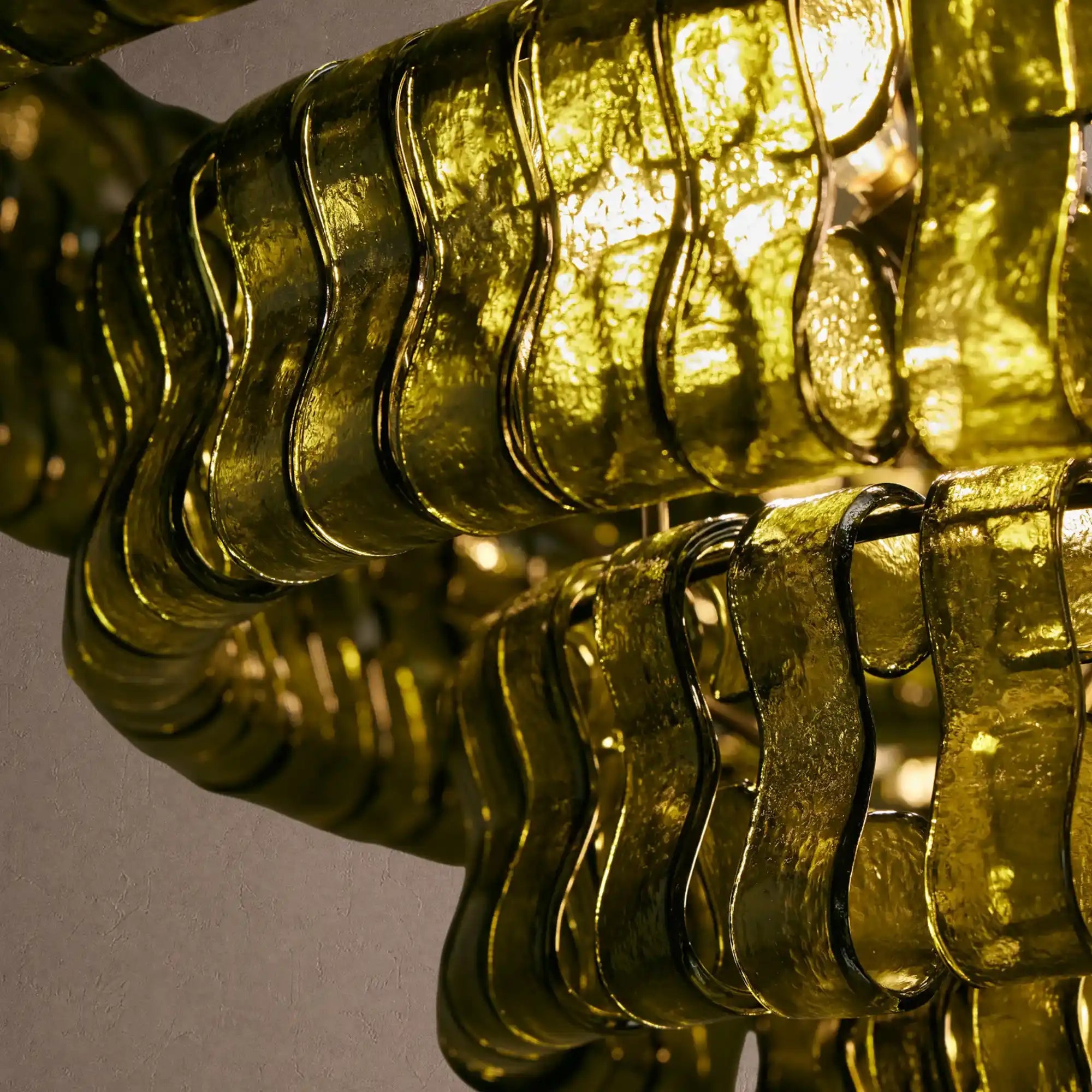
The same Grigio silhouette in smoked glass has a darker outline against the wall.
Compare this image with the clear version above. Keeping the frame and form consistent makes the effect of the tint easier to judge. Smoke with brass feels warm and substantial; smoke with black reads more graphic. Both can work in a modern interior, depending on how much contrast you want overhead.
Tint also affects transmission. The amount varies with the glass, so there's no reliable percentage you can apply to every smoked chandelier. A darker shade may look appealing when illuminated but contribute less light through the glass than a clear one. Consider the rest of the room's lighting before choosing it as your main source.
Smoke alone doesn't guarantee low glare. A bright lamp may still be visible through a tinted panel. Look for an illuminated close-up, and check the view from where you'll actually sit. If you love the darker glass, a separate lamp or pair of sconces can help light the room without pushing the chandelier to full output.
Our guide to placing sconces and pendants around a chandelier explains how to add that second layer.
Opal glass: let the shade carry the light
Opal glass has a milky appearance and diffuses the light passing through it. Instead of seeing a small, bright source clearly, you see a larger glowing surface. It's an appealing choice for a bedroom, a reading area or a living room where the fixture stays within view for long periods.
That white surface remains visible during the day. In a room with cream plaster, linen and pale oak, it can feel calm and continuous. Against a dark ceiling, white globes become a deliberate contrast. Think about both settings before deciding.

Cassano in Matte Opal conceals the internal light source behind a white glass surface.
The Cassano Modern Round Chandelier offers Matte Opal or Crackle glass on stainless steel fittings with a satin brass finish. Its mouth-blown globes hang on individually adjustable cables. The 20-inch version is 20 inches wide and deep, with three integrated LED lights totaling 15 watts. That wattage describes power consumption; it doesn't tell you the fixture's lumen output.
We'd start with Matte Opal for a sitting area with upholstered furniture and relatively quiet finishes. Adjust the cable lengths to suit the room while keeping the lowest globe above the required clearance. Because Cassano uses integrated LEDs, confirm the color temperature and dimming compatibility for your chosen configuration before ordering.
Opal is often described alongside frosted glass, but the names aren't interchangeable. Frosting is a surface treatment; opal refers to the milky glass appearance. Either may diffuse light, and the actual result depends on the shade's construction and the source behind it. Opal can still be too bright at full output, so diffusion and dimming deserve separate attention.
Textured glass: choose the pattern you want to see
Reeded glass has repeated linear grooves. Crackle glass has a fine irregular pattern. Each gives the shade a surface that catches light differently as you move around it.
Texture is particularly useful in a room built from broad, smooth surfaces. Beside honed stone, flat cabinetry or plain plaster, it adds detail without requiring another color. If the room already has patterned wallpaper, decorative moldings and a strongly veined table, a simpler shade may be easier to live with.

Cassano in Crackle glass keeps the same globe arrangement while adding visible detail around the light.
Cassano is a useful comparison here: Matte Opal and Crackle are choices within the same design. In the images above, the white globes create more solid shapes, while the crackle version shows detail within the illuminated glass. That decision can be made separately from the overall size of the fixture.
Reeded glass over a long dining table

Dorsey's elongated form follows the dining table, with reeded panels providing the surface detail.
The Dorsey Oval Chandelier arranges reeded glass panels around a steel frame and offers Clear or Smoke glass. The smallest listed size is 51.5 inches wide × 22 inches deep × 12 inches high. Those are the fixture body's dimensions, separate from its hanging drop.
Its long profile suits a rectangular or oval table. We'd pair the clear version with a dark wood tabletop and plain upholstered chairs, giving the glass some contrast without adding competing patterns. Smoke makes the outline stronger, so consider how it will read against the ceiling as well as the table below.
The 51-inch size is listed at 92.37 pounds, and the product page calls for professional installation and additional ceiling support for fixtures over 50 pounds. Include the mounting requirements in your planning; transparent glass can still be part of a substantial fixture.
Texture doesn't automatically conceal a bright source. Ask for a close-up with the fixture illuminated if you're unsure how much of the lamp remains visible through the panels.
Match a glass chandelier to your table shape
Glass changes the visual weight of a fixture, but you still need the right physical footprint. Use the table to set the initial scale, then adjust for the density of the design.
Round tables
For a round table, start with a chandelier diameter around one-half to two-thirds of the table diameter. A 54-inch round table gives you an initial range of 27–36 inches.
A clear design may feel more open than an equally wide group of opal shades. Compare how much of the circle is actually filled, rather than assuming all 36-inch fixtures occupy the room in the same way.
Rectangular tables
For an elongated chandelier, use one-half to two-thirds of the table length as a starting range, then check its depth against the table width. A 96 × 44-inch table suggests roughly 48–64 inches of fixture length. Leaving about 6 inches inside each long edge gives a practical starting limit of 32 inches of fixture depth.
If you're considering a single round chandelier instead, check its diameter against the table's shorter dimension. Using the full table length to size a circular fixture can leave it wider than the tabletop.
Oval tables
An oval or softly elongated fixture follows the table's long axis without introducing hard corners. Apply the same initial length range as for a rectangular table, then check the outline near the table's narrower ends. A full rectangular bounding box won't show you where an oval tabletop curves away.
These are proportion guides. The final choice should also allow comfortable sightlines and appropriate mounting. Our dining room chandelier guide covers the measurements in more detail.
Hanging height, Kelvin and lumens
Over a dining table, 30–36 inches from the tabletop to the fixture's lowest point is a useful starting range. Sit down before fixing the final drop. With clear or smoked glass, check whether the lamps face you through the shade; with a globe cluster, measure to the lowest globe.
For open circulation areas, keep the fixture clear of the walking route and follow the site's size guide and your installer's requirements. A long maximum cable length is an installation option, not a recommendation to use the full drop.
For the warm residential settings shown here, we'd usually start at 2700–3000K where that option is available. Choose according to the product's listed options and the other lights visible in the same room. Smoked glass may change the appearance of transmitted light, but it doesn't set the LED's Kelvin rating.
Lumens measure light output; watts measure power consumption. Six replaceable bulbs rated at 400 lumens each would provide 2,400 source lumens before losses through the fixture. That calculation won't tell you the output of an integrated LED chandelier or the amount reaching your table. For those questions, ask for the fixture's specified output and consider the room's other light sources.
If color accuracy is a priority, look for CRI 90 or above when selecting compatible replacement bulbs. For integrated LEDs, ask about the supplied light source. Confirm dimming support and the required control separately; glass color doesn't determine whether a fixture can dim.
Our chandelier bulb guide explains bases, color temperature and dimmer compatibility. The U.S. Department of Energy's lighting guidance also explains output, color and compatibility.
Check the glass in daylight and after dark
Before ordering, compare a product view with an interior image and an illuminated close-up. The product view helps you see the material; the room image shows scale. An illuminated detail helps you judge the light source, although camera exposure can make a shade look brighter or softer than it will in person.
Check the selected glass option carefully. A clear version used in the main photograph may share a listing with smoke, and a crackle globe may share a listing with opal. The image you like and the option in your order should agree.
Ask how individual shades or panels are removed for cleaning, and how replacements can be ordered. Follow the fixture's care instructions. For general maintenance, our chandelier cleaning guide is a useful place to start.
If you're shopping specifically for Murano, glass appearance alone won't establish origin. Check the information for that particular design and use our Murano chandelier guide for a closer look at the forms in the collection.
Find the glass that belongs in your room
Picture the chandelier with the lights off as well as on. Clear glass keeps more of the room visible through it. Smoke gives the fixture a darker outline. Opal turns the shade into a glowing surface, while reeded and crackle glass add detail.
Once you've chosen that effect, check the dimensions and light source for the exact version you want. Browse our glass chandeliers and pendants, or send us your table dimensions, ceiling height and a room photograph so we can help you narrow the options.
Frequently asked questions
Is clear or opal glass better for a chandelier?
Clear glass suits rooms where you want an open view through the fixture and visible reflections. Opal glass diffuses light across a milky shade and conceals more of the source, making it a useful starting point for bedrooms and sitting areas. Check the brightness and lamp position with either option.
Does smoked glass make a chandelier too dark?
Smoked glass reduces transmission to a degree that depends on its tint and construction. It can work well when the chandelier is part of a layered lighting scheme. Check the specified output, view an illuminated image and consider the room's other lights before choosing it as your main source.
Does textured glass prevent glare?
Reeded and crackle glass change the appearance of light, but they don't guarantee that a bright source will be concealed. Comfort depends on the glass, lamp position, output and viewing angle. Compare illuminated close-ups, check from a seated position, and confirm dimming compatibility for the fixture you're considering.


