
The Blushlighting Journal
A fine fixture stays beautiful for decades with a little care — but the right method depends entirely on what it’s made of. The cleaner that revives crystal can ruin alabaster. Here’s how to clean and maintain lighting the right way, material by material.
Before you touch a thing
The five golden rules
- — Cut the power first. Switch off at the wall and let warm bulbs cool completely.
- — Spray the cloth, never the fixture. Keep all moisture away from sockets and wiring.
- — Wear lint-free gloves for crystal and glass. Skin oils leave fingerprints that show.
- — Never wet natural stone. Alabaster, marble, and onyx are porous — liquids stain them permanently.
- — Match the cloth to the finish. Dry, soft microfiber for metal; skip abrasives, ammonia, and polish.
| Task | How often |
|---|---|
| Dust the fixture | Monthly |
| Wipe crystal & glass | Every 3 months |
| Full deep clean | 1–2× a year |
| Check bulbs & connections | Yearly |
The Material Guide
How to clean it, material by material
Find your fixture’s material below. When a piece combines several, treat each part by its own rule — and when in doubt, go gentler.
Crystal
Clean Dust often with a soft brush or microfiber. For a deep clean (power off), wash detachable crystals in one part white vinegar to three parts warm water, then dry each piece immediately with a lint-free cloth. Wear gloves. For fixed crystals, mist the cloth — not the fixture — and wipe.
Avoid Cleaning while it’s powered, abrasive cloths, and letting droplets air-dry (they leave spots).
Alabaster, Marble & Onyx
Clean Dust only, with a dry, soft microfiber or a clean makeup brush for crevices. Keep it dry. For a stubborn mark, a barely-damp cloth with plain water, wiped and dried instantly — sparingly.
Avoid Water, soap, sprays, and polish of any kind — this stone is porous and stains or dulls permanently. Never use acidic or vinegar-based cleaners on marble; they etch it.
Ceramic & Porcelain
Clean A dry or barely-damp soft cloth for everyday dust. Glazed pieces can take a little mild soapy water — wipe gently and dry well afterward.
Avoid Abrasive pads and harsh chemicals (they scratch the glaze), and soaking unglazed or crackle-glaze pieces, where moisture seeps in and marks.
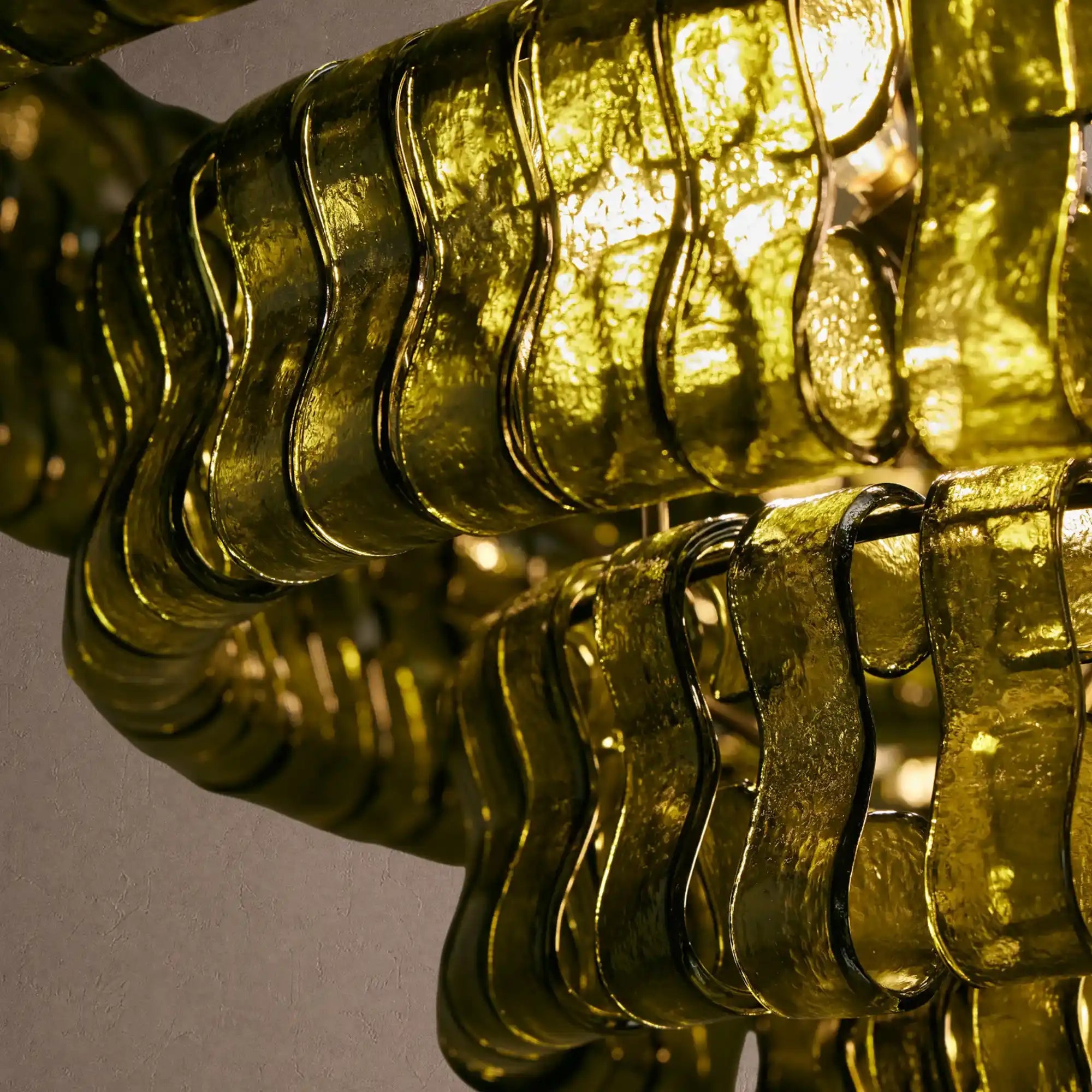
Hand-Blown & Murano Glass
Clean A soft cloth for dust; for more, a cloth dampened with warm water and a drop of mild dish soap, then dry. Support each piece — hand-blown glass is delicate at the joints.
Avoid Harsh glass sprays on colored or cased glass, immersing a live fixture, and any pressure where pieces join.
Brass & Warm Metals
Clean A dry microfiber is all lacquered brass needs. Unlacquered “living finish” brass can be brightened with a gentle brass cleaner — though many owners love the warm patina it earns over time.
Avoid Metal polish and abrasives on lacquered finishes (they strip the coating), ammonia, and any lingering moisture.
Chrome & Nickel
Clean A microfiber lightly dampened with water, then buffed dry right away to prevent water spots and streaks.
Avoid Abrasives and acidic cleaners, which pit and dull the plating over time.
Wood & Rattan
Clean Dry-dust regularly with a soft cloth or brush; an occasional wipe with a barely-damp cloth, dried immediately.
Avoid Soaking, silicone sprays, and leaving anything damp — wood warps and rattan can mildew.
Fabric & Paper Shades
Clean Lift dust with a lint roller or a vacuum brush attachment on low suction, working top to bottom.
Avoid Water on paper or silk, and spot-cleaning that leaves rings — dust regularly instead so it never builds up.
Bulbs, wiring & when to call a pro
Replace bulbs like-for-like — same base and wattage, and a dimmable LED if you’re on a dimmer — to protect both the fixture and the switch. If a whole fixture flickers or dims, it’s almost always the bulb or dimmer, not the piece. Keep water and cleaner away from every socket. And for large, heavy, or high-hung fixtures — a two-story foyer, a grand crystal chandelier — bring in a professional to take it down for cleaning or rewiring. It’s safer for you, and for the piece.
Match the method to the material.
Dust often, clean gently, and treat each material by its own rule — and your lighting will shine for years to come.


